Spinneret
Self-healing Lead Intelligence
Scrapers that diagnose and repair themselves. Spinneret is a buying-signal radar that measures every scrape against a contract, writes its own repair prompt from the telemetry when data drifts, and proves the fix with a before and after score.

- 20 → 97
- Health score, healed
- 57
- Unit tests
- 3
- Live collectors
- 7
- Loop stages
Demo video
Demo video coming soon
A full walkthrough of Spinneret will be added here.
A collector breaking, being diagnosed and healing itself.
Overview
Spinneret is two systems that need each other.
The first watches niche public sources for the moment a company commits money to something specific, then ranks those companies by how likely they are to buy right now, with the reasoning attached to every score.
The second keeps that feed honest. Scrapers break quietly, so after every run Spinneret measures what came back, compares it against a contract, and when the data stops matching it writes its own repair prompt from those measurements, sends it through Bright Data Scraper Studio, approves the patch and re-runs to prove the fix worked.
Built for Into the Scrape-Verse, the Bright Data and WeMakeDevs hackathon, in August 2026.
The Problem
Scrapers rarely fail loudly.
A site ships a redesign, a CSS selector stops matching, and the extraction code keeps running perfectly. Same row count, same schedule, same green job. The rows are simply empty.
Nothing in a normal pipeline notices. HTTP returned 200 and no exception was thrown. Three weeks later a sales team reports that leads dried up, and someone starts bisecting a month of data to find when the values turned into nulls.
A lead-signal product that silently goes stale is worse than no product at all, because it converts “I do not know” into “I am confidently wrong”. Freshness is the entire value proposition, so self-healing is not a bonus feature here. It is what makes the core promise true.
Goals of the Project
| Goal | How it is met |
|---|---|
| Score change, not existence | Signals come from what shifted this week, never from a static directory dump. |
| Make every score arguable | Each point traces to a stated rule, shown in the interface. |
| Detect silent decay | Every run is measured against a contract written independently of the scraper. |
| Repair without a human | The prompt sent to Bright Data is generated from telemetry. |
| Prove the repair worked | Before and after scores are recorded side by side in a durable ledger. |
| Know when not to act | Vague evidence and transport failures are explicitly excluded from healing. |
System Architecture
Four layers, with dependencies pointing in one direction only. Nothing in the domain core imports a database, a network client or a React component, which is what lets the self-healing decision logic be unit-tested with no I/O at all.
src/
├─ app/, components/     interface: dashboard, docs, HTTP routes, SSE feed
├─ services/             sentinel loop, scheduler, background jobs, read model
├─ adapters/, db/        the only modules that spawn the CLI or write SQL
└─ core/ health, drift, prompts, signals, cooldown (imports nothing)The Self-Healing Loop
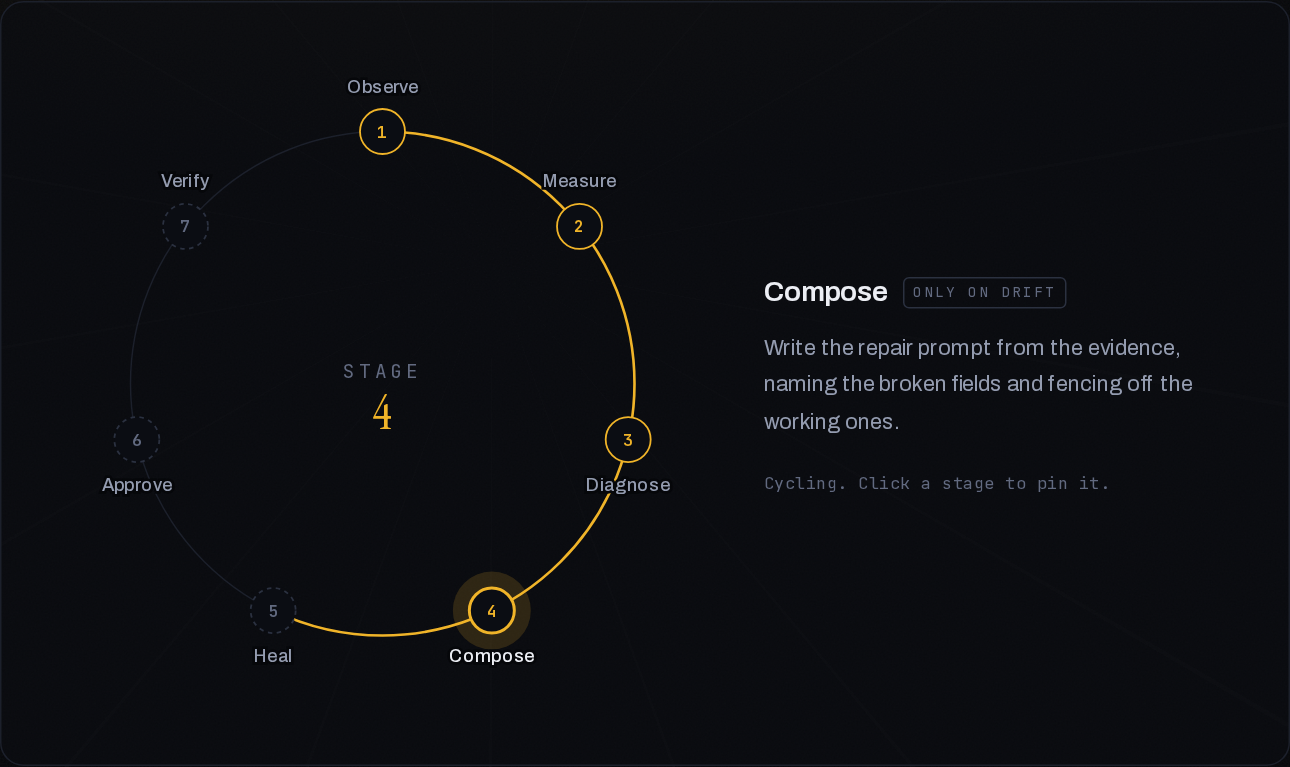
Seven stages. The first three run on every observation. The last four only run when the diagnosis found evidence worth acting on.
Key Features
Machine-authored repair prompts
This is what separates Spinneret from a monitoring dashboard. The instruction sent to Bright Data is assembled from measurements, not typed by a person.
The scraper for Remote GTM job board (https://weworkremotely.com/categories/
remote-sales-and-marketing-jobs) is returning incomplete data. Fields never
returned as keys in the output: company_name, job_title, location, job_url.
Re-derive selectors for company_name, job_title, location, job_url from the
current live DOM and return the full contracted schema: company_name,
job_title, location, job_url.Four clauses, each doing a job: name the target, state the evidence with specific fields, say what to do and where to look, and restate the required schema so a partial repair is not mistaken for success. When a collector is only partially broken, a fifth clause appears automatically, fencing off the fields that still work so a rewrite cannot regress them.
The Contract Lab
Everything else on the dashboard is retrospective. It reports that a collector went from 20 to 97 and asks to be believed. The Contract Lab lets you test it. Change what a collector is required to return and the whole diagnosis re-runs in front of you: coverage moves, evidence assembles and the repair prompt types itself out.
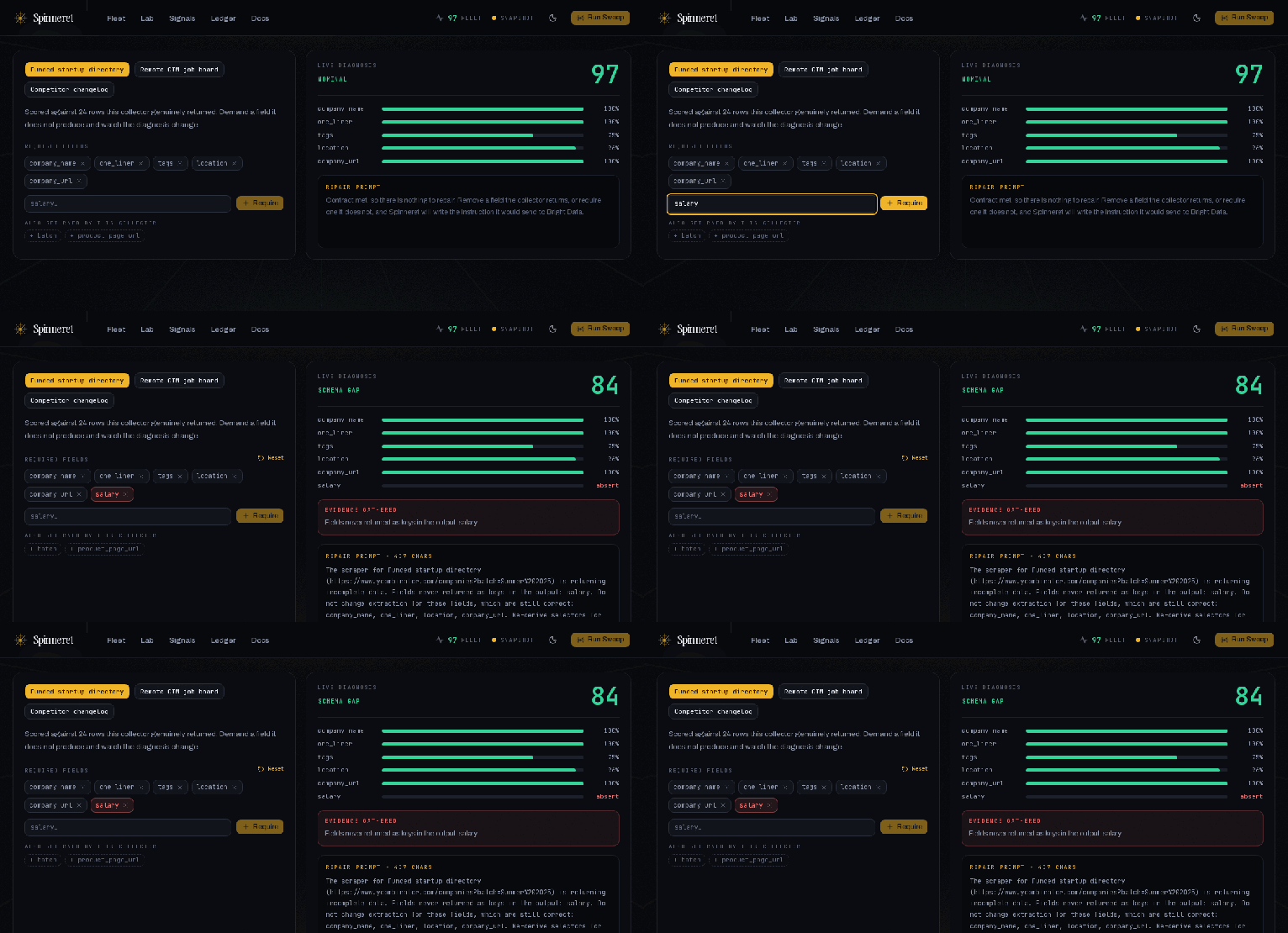
None of it is simulated. The rows are ones those collectors genuinely returned, and the scoring, drift classification and prompt composition are the same functions the sentinel runs in production. It runs entirely in the browser, which is a direct payoff from the architecture: the scoring layer performs no I/O, so it ships to the client and works on the hosted snapshot with zero latency.
Health scoring
Every run produces one number between 0 and 100 from three weighted terms.
| Component | Weight | Meaning |
|---|---|---|
| Coverage | 0.50 | Mean fill rate across contracted fields |
| Schema conformance | 0.30 | Fraction of contracted fields present as keys |
| Yield | 0.20 | Row count against the rolling healthy baseline |
A value only counts if it carries information. null, empty strings, whitespace and the literal strings "null", "N/A" and "undefined" all count as missing, as do empty arrays and objects. Broken scrapers emit these constantly, and treating them as real data is exactly how a hollow pipeline passes as healthy.
Drift detection
Each snapshot is classified into a severity that decides whether a heal is allowed.
| Severity | Rule | Heals? |
|---|---|---|
schema_gap | A contracted field is absent as a key | Always |
critical | Composite score below 55 | Always |
degraded | Score below 80, or a field regressed against baseline | Only if a specific field was identified |
unreachable | The run never completed | Never |
healthy | Everything within tolerance | No action |
The unreachable case matters more than it looks. A timeout returns nothing, so every field appears absent, which is indistinguishable from a total site rewrite. Healing in that state spends a cycle and hands the healing AI no live DOM to work from.
Buying signal engine
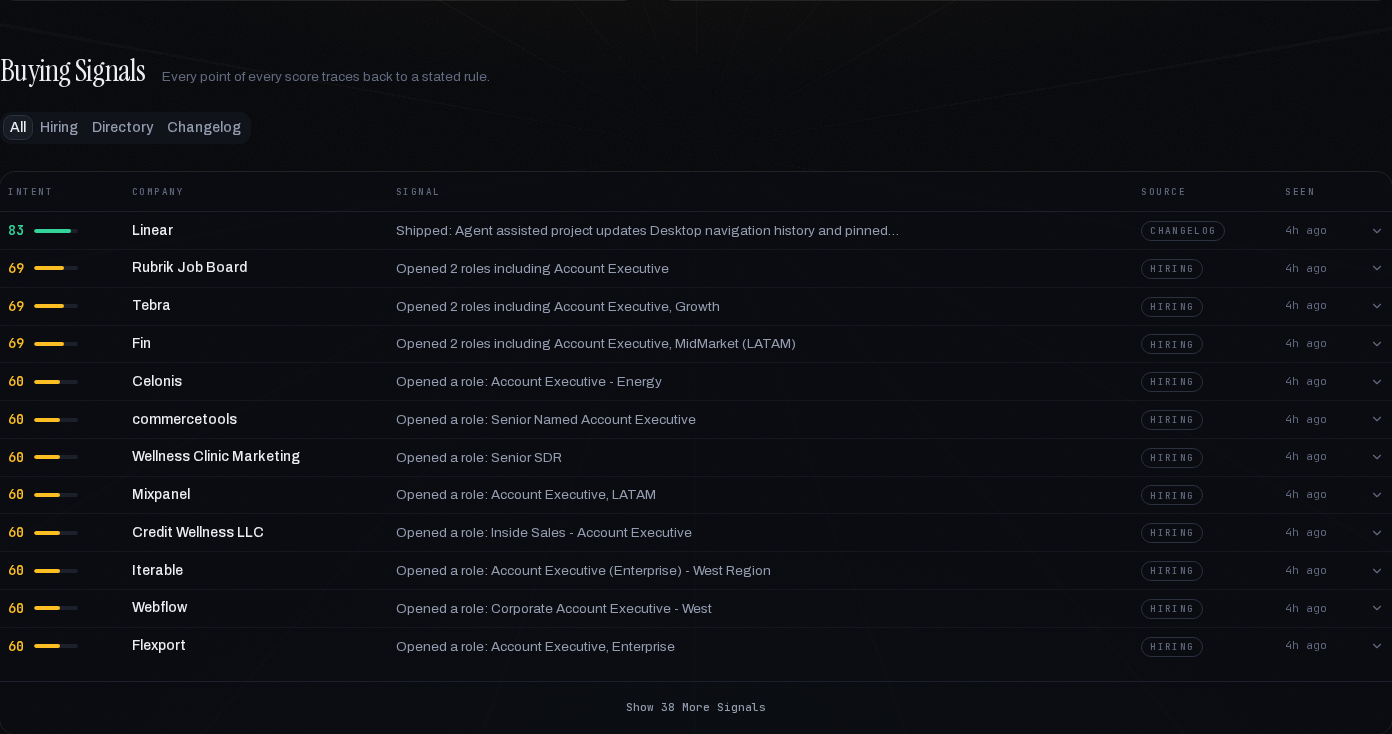
Each source type gets its own rule table, because a job title, a changelog entry and a directory listing say different things about intent.
| Source | Rule | Points | Reasoning |
|---|---|---|---|
| hiring | GTM leadership hire | 34 | New leaders re-tool their stack within a quarter |
| hiring | RevOps hire | 32 | An explicit mandate to buy and integrate tooling |
| hiring | Revenue-carrying role | 30 | Quota capacity is being added |
| changelog | Enterprise readiness | 34 | SSO, SCIM and audit logs mean larger deals ahead |
| changelog | Integration surface | 26 | Points to an ecosystem play |
| directory | B2B software | 24 | Buys tooling as a matter of course |
| any | Newly appeared | 22 | The change is fresh, not historical |
| any | Concurrent activity | up to 27 | Coordinated build-out rather than backfill |
When no rule fires, no signal is emitted. Spinneret never invents intent it cannot justify, and there is a unit test asserting exactly that.
Unattended supervision
A cron-driven watcher sweeps the fleet every 30 minutes by default. Two safeguards matter for a loop that spends money without a person watching.
- A sweep can outlast its own interval during a slow heal, so a late tick is skipped rather than queued. Overlapping runs would corrupt the shared baseline.
- A heal that ran and did not raise the score is never retried on a timer. Re-sending a prompt already shown not to work burns credits and can degrade the scraper further.
Live Collectors
Three collectors, deliberately different in shape so they exercise different parts of the health model: a paginated list, a JavaScript-rendered directory with an array field, and a single-subject changelog with no company column at all.
| Collector | Target | Signal |
|---|---|---|
hiring-signals | WeWorkRemotely GTM job board | Hiring intent, revenue roles opening |
funded-startups | YC directory, Summer 2025 | New entrants, scored on sector fit |
product-velocity | Linear changelog | Product velocity, enterprise-readiness work |
Every target is public, carries no personal data, sits behind no login or paywall and has no pre-built Bright Data scraper. LinkedIn was deliberately avoided precisely because it already has one, and using it would have meant not really using Scraper Studio.
The self-healing demonstration was not staged
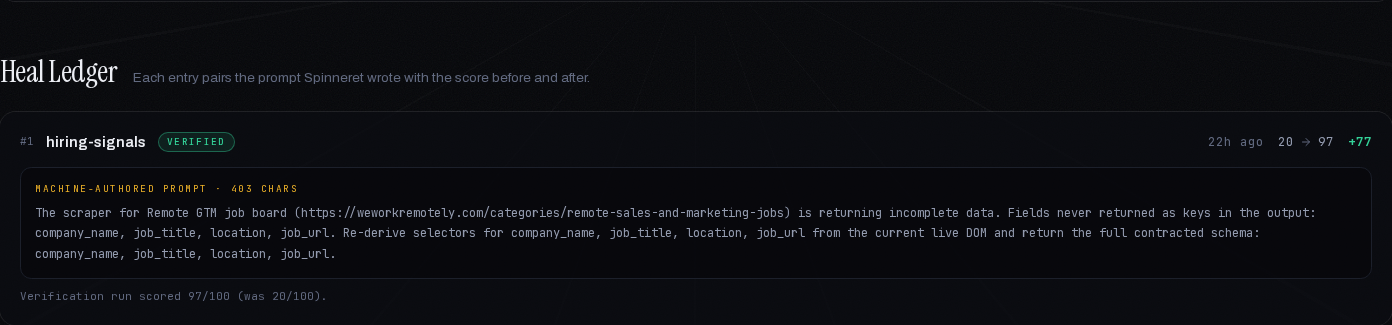
The hiring-signals collector was created from the description “extract every job listing: job title and company name” and came back returning 66 rows containing only product_page_url. Neither contracted field was present. Spinneret found that on its first observation, scored it 20/100, classified it schema_gap and dispatched a heal on its own evidence. The verification run scored 97/100, and the flight recorder holds the full trace.
Tech Stack
| Layer | Choice | Why |
|---|---|---|
| Scraping | Bright Data Scraper Studio | AI-built collectors with a heal API and a stable collector ID |
| Framework | Next.js 16, App Router | One repo for dashboard, docs and API, with SSE support |
| Language | TypeScript, strict | The domain core is the part that must be provable |
| Storage | SQLite via better-sqlite3 | Zero-config durable flight recorder, lazily required |
| UI | shadcn/ui on Base UI, Tailwind v4 | Accessible primitives, tokens remapped onto the palette |
| Motion | Framer Motion + GSAP | Staggered reveals, and the web scaffold drawn on load |
| Type | Instrument Serif, Archivo, JetBrains Mono | A deliberate pairing, not a default stack |
| Testing | Vitest | 57 unit tests over pure functions, no mocks needed |
| Scheduling | node-cron | Unattended fleet supervision |
Database Design
Two details are worth noting. expected_fields is a contract written independently of the scraper, which is what lets the sentinel notice a gap nobody told it about. And signals.fingerprint is derived from what was observed rather than how it was worded, so re-observing the same job openings is silent while a genuinely new posting still creates a signal.
Application Flow
Challenges and Solutions
| Challenge | Solution |
|---|---|
| A broken scraper would define its own idea of “correct” | The contract is written by hand, independently of what the scraper currently returns. |
| One catastrophic run poisoning the baseline | Baselines use the median, and are built only from runs that already scored well. |
| A timeout looking identical to a total site rewrite | Failed runs are classified unreachable and excluded from healing. |
| Vague prompts making a working scraper worse | Healing is withheld unless a specific field is identified. |
| A failed heal being retried forever on a timer | A pure cooldown policy blocks retries, and is exhaustively unit-tested. |
| Re-observing creating duplicate signals | Identity is a fingerprint of what was observed, never the formatted headline. |
| Serverless cannot write SQLite or run a 25-minute heal | The hosted build serves a committed JSON snapshot and says so in the header. |
| A failed native build taking down the whole site | better-sqlite3 is required lazily, so the snapshot path never loads it. |
Best Practices
Architecture and testing
The domain core imports nothing: no database, no network, no filesystem, no React. That constraint is load-bearing. The self-healing decision logic runs in a unit test without a Bright Data account, and the same purity is why the Contract Lab can run in the browser. 57 tests cover the scoring, the drift thresholds, the prompt budget, the signal rules and the retry policy.
Reliability
Every score is measured from a real run and never asserted. A heal is only credited once a verification run records a higher number next to the one it replaced, and the system can report failed, which is what makes it trustworthy when it reports verified.
Accessibility and design
Focus is visible everywhere, icon-only controls carry aria-label, the SVG fleet view exposes an accessible description and every animation stops under prefers-reduced-motion. The vitals ramp darkens in light mode to hold a 4.5:1 contrast ratio, and content is present in the markup so the page stays readable without JavaScript.
Security
The API token is passed through the environment rather than a CLI flag, so it never appears in a process listing. .env.local is gitignored and excluded from deployment uploads, and no scraped personal data enters the system by design.
Deployment and Data Ethics
The hosted build is a showcase, not a control plane, and the header says SNAPSHOT rather than LIVE. A serverless filesystem is read-only, and a heal runs for five to twenty-five minutes shelling out to the Bright Data CLI, far outside any request lifetime. Rather than ship buttons that fail, the deployed build serves a committed snapshot of real runs and disables those actions with tooltips explaining why. The Contract Lab stays fully interactive, because the scoring layer needs no I/O.
Public sources only. No login-walled or paywalled content, and no personal data. Signals are scored at company level and derived from public job postings, directory listings and published changelogs. A job posting contributes its title and its employer, never a named person.
Conclusion
Most scraping projects treat breakage as an operational chore to be handled later. Spinneret treats it as the central design problem, because a signal product whose data quietly goes stale is worse than one that does not exist.
The result is a system that measures itself after every run, writes its own repair instructions from those measurements, and records the before and after so the claim can be audited rather than believed. One collector went from 20 to 97 that way, and the Contract Lab exists so anyone can reproduce the reasoning instead of taking my word for it.